
.JPG)
Friday, August 16, 2013

Sunday, July 28, 2013
Plants on Vacation

There are many Lilium superbums with flaming petals and tall stalks. Asclepias incarnata, Hibiscus, and swaths of Joe Pye Weed and Cattails and Rush.
.JPG)
.JPG)

.JPG)
Of course the wild grape, Japanese honey suckle, and knotweed loom large. The whole forest floor is covered with Euonymus. But I try to focus on the beautiful plants I love, enjoy seeing them in nature and not get depressed that all this habitat is being crowded out.....
Monday, July 22, 2013
Queen of the Night - night-blooming cereus
I was lucky enough to come across the beautiful bloom of the night-blooming cereus. The cactus blooms just one-night of the summer and dies as the sun rises. With its strong, sweet scent, it attracts nocturnal creatures like Sphinx moths (sometimes called the hummingbird moths because they resemble the bird as hover to feed) and bats to be its pollinators. I captured a bit of the magic here.


And, thanks to the wonders of the internet, you can see it too:


And, thanks to the wonders of the internet, you can see it too:
Thursday, July 18, 2013
A bit more about that Tax Abatement Extension
A few weeks ago S.W.I.M. announced the extension and improvement of the NYC green roof tax abatement. I thought I'd go into more detail about changes to the abatement and how it helps you to build a green roof now!
Let's start with a quick summary of the current abatement from S.W.I.M.'s coordinator Rob Crauderueff:
Financially, the old abatement just didn't cut it. The reduced rate of $4.50/s.f. was too low to be appealing to private building owners, the amortization schedule reduced the value, and perhaps most disappointing, the administrative costs to implement a green roof could add $7.50/s.f. for a 10,000 s.f. green roof to about $19/s.f. for a 1,000 s.f. green roof.
Oh, and don't forget about all that time it takes to jump through those administrative hoops! Crauderueff sites that 3 out of 4 successful applicants spent over 100 hours of staff time on the process.
The abatement required that 80% of the roof must be covered with vegetation one year after application and specifically sited sedum as the go-to filler. Now, don't get me wrong, I think sedum is a beautiful and productive plant, but I stick with the Benjamin Franklin model - everything in moderation. Using pre-grown vegetative mats also increased costs.
Finally, non-profits and affordable housing owners couldn't benefit from the abatement, cutting out an interested and willing population.
The extension does not address all of the problems that Crauderueff and partners suggested, but there are some exciting improvements.
The definition of 'green roof' was expanded to allow for the inclusion of a controlled flow roof drains, specifying that if the depth medium is less than three inches, a controlled flow drain or other preventative drying method can be added.
New native and agricultural plant species were added to the list of "live plants" that can be used to meet the requirement of the 80% vegetation coverage. Opening the abatement up to rooftop farms and plants other than sedum.
The amount of the abatement was increased to $5.23/s.f. beginning July 1, 2014, which actually was just meant to keep the abatement in line with pricing increases, but we'll take it. Also the maximum was raised to $200,000 (up from $100,000), mostly meant to help out the more expensive rooftop farms.
The bill from the state legislature does not mention improving administrative procedures, so our fingers are crossed that some streamlining will happen with the implementation of the extension.
The point of these new incentives is part of a larger green infrastructure program in the city to capture the first ince of rainfall on 10% of the impervious areas in combined sewer watersheds through detention or infiltration techniques. But, because green roofs have so many other sustainability benefits, the abatement is open citywide.
Which makes me think, wouldn't it be great if individuals could register their own tiny improvements as part of the city's goal - registering window boxes, street planters, gardens, and native plants not only for tax credits (one can dream) but also to create a wider community around conservation efforts.
Here's to hoping. If you'd like to get involved, become a member of S.W.I.M. The group just announced their July meeting (Wednesday, July 24) where they'll discuss the Green Roof Tax Abatement in more depth.
Let's start with a quick summary of the current abatement from S.W.I.M.'s coordinator Rob Crauderueff:
Financially, the old abatement just didn't cut it. The reduced rate of $4.50/s.f. was too low to be appealing to private building owners, the amortization schedule reduced the value, and perhaps most disappointing, the administrative costs to implement a green roof could add $7.50/s.f. for a 10,000 s.f. green roof to about $19/s.f. for a 1,000 s.f. green roof.
Oh, and don't forget about all that time it takes to jump through those administrative hoops! Crauderueff sites that 3 out of 4 successful applicants spent over 100 hours of staff time on the process.
The abatement required that 80% of the roof must be covered with vegetation one year after application and specifically sited sedum as the go-to filler. Now, don't get me wrong, I think sedum is a beautiful and productive plant, but I stick with the Benjamin Franklin model - everything in moderation. Using pre-grown vegetative mats also increased costs.
Finally, non-profits and affordable housing owners couldn't benefit from the abatement, cutting out an interested and willing population.
The extension does not address all of the problems that Crauderueff and partners suggested, but there are some exciting improvements.
The definition of 'green roof' was expanded to allow for the inclusion of a controlled flow roof drains, specifying that if the depth medium is less than three inches, a controlled flow drain or other preventative drying method can be added.
New native and agricultural plant species were added to the list of "live plants" that can be used to meet the requirement of the 80% vegetation coverage. Opening the abatement up to rooftop farms and plants other than sedum.
The amount of the abatement was increased to $5.23/s.f. beginning July 1, 2014, which actually was just meant to keep the abatement in line with pricing increases, but we'll take it. Also the maximum was raised to $200,000 (up from $100,000), mostly meant to help out the more expensive rooftop farms.
The bill from the state legislature does not mention improving administrative procedures, so our fingers are crossed that some streamlining will happen with the implementation of the extension.
The point of these new incentives is part of a larger green infrastructure program in the city to capture the first ince of rainfall on 10% of the impervious areas in combined sewer watersheds through detention or infiltration techniques. But, because green roofs have so many other sustainability benefits, the abatement is open citywide.
Which makes me think, wouldn't it be great if individuals could register their own tiny improvements as part of the city's goal - registering window boxes, street planters, gardens, and native plants not only for tax credits (one can dream) but also to create a wider community around conservation efforts.
Here's to hoping. If you'd like to get involved, become a member of S.W.I.M. The group just announced their July meeting (Wednesday, July 24) where they'll discuss the Green Roof Tax Abatement in more depth.
Tuesday, July 16, 2013
Surviving the Heat Wave
Ugh. This entire week promises to embroil the city in a disgusting heat wave. Hot and humid.
There are tons of Mosquitos. Remember - you can reduce mosquitos in your backyards by making sure there are no
pots or barrels collecting water, and that your gardens drain well.
Geraniums and catnip supposedly repel mosquitos, but not sure that really works....
Many
plants leaves droop in the heat even if they have enough water, like
dogwoods, some hydrangeas, and also clethras. Make sure anything in pots
is well watered!
Wish we had more dragon flies and frogs to eat the buzzard!
Friday, July 12, 2013
Native Appreciation: Shady Love
In this weather, its hard to believe anyone could have a problem with shade. Heat waves one minute, giant storms the next, it all makes me want to run for cover! But shady backyards can pose a problem for the best city gardner.
.JPG)
Enter twinleaf (Jeffersonia diphylla). Its a great native plant that can thrive in the shade. When it flowers - don't blink, you might miss it - it has a single white flower. You'll notice that it's leafless stalk is topped by, you guessed it, a leaf divided lengthwise into two twin halves. It is a short plant that will add a lush green to your space.
On a historical note - the plant was named for Thomas Jefferson by his friend, William Bartram, and, besides the United States, is only found in Japan. Native Americans are said to have used the roots to ease cramps, treat liver problems & urinary infections, and as a gargle for sore throats. Early Americans also used it to cure many of the same ills, but don't get any ideas - the plant is now considered poisonous!
It is listed as endangered in Georgia and New Jersey, and threatened in Iowa and here in New York. Planting it in your garden not only adds beauty but also helps keep this little guy around.
.JPG)
Enter twinleaf (Jeffersonia diphylla). Its a great native plant that can thrive in the shade. When it flowers - don't blink, you might miss it - it has a single white flower. You'll notice that it's leafless stalk is topped by, you guessed it, a leaf divided lengthwise into two twin halves. It is a short plant that will add a lush green to your space.
On a historical note - the plant was named for Thomas Jefferson by his friend, William Bartram, and, besides the United States, is only found in Japan. Native Americans are said to have used the roots to ease cramps, treat liver problems & urinary infections, and as a gargle for sore throats. Early Americans also used it to cure many of the same ills, but don't get any ideas - the plant is now considered poisonous!
It is listed as endangered in Georgia and New Jersey, and threatened in Iowa and here in New York. Planting it in your garden not only adds beauty but also helps keep this little guy around.
Wednesday, July 10, 2013
River to River - Artists Take On Water

The festival goes through this weekend, but the exhibit will be open until August 2.
Friday, July 5, 2013
Fields of Yellow
Checking in on a project from last fall & I was transported to a sea of yellow!

We installed these pre-grown sedum trays at New York Hospital Queens (NYHQ) - 15,000 SF in all. The sedum will help to regulate and capture stormwater runoff during wet weather, so we've been watching it do its job all week. The roof is visible from many patients' rooms, so this golden oasis can add a bit of brightness to these grey days!
Sedum is a water-holding plant that also has drought tolerance. It can grow in many colors, but ours grew in with the cheery hue of sunshine! It has a special type of metabolism called "Crassulacean Acid Metabolism' (CAM) which, during draught conditions, allows it to open its leaf pores at night rather than during the day, making it more efficient than non-CAM plants. We got our trays from LiveRoof, a great network of green roof growers.
The roof will be monitored by Manhattan College students, who will be measuring its impact on local water systems. Making it not only a beautiful site, but also a learning space.

The greenroof at NYHQ was just one aspect of the hospital's plan to reduce their environmental impact. They also replaced old equipment with newer high efficiency models, began a recycling program - the hospital was the first to meet Mayor Bloomberg's challenge to NYC hospitals, universities, and businesses to reduce overall carbon emissions by 30 percent over ten years. NYHQ met that goal in just two!


We installed these pre-grown sedum trays at New York Hospital Queens (NYHQ) - 15,000 SF in all. The sedum will help to regulate and capture stormwater runoff during wet weather, so we've been watching it do its job all week. The roof is visible from many patients' rooms, so this golden oasis can add a bit of brightness to these grey days!
Sedum is a water-holding plant that also has drought tolerance. It can grow in many colors, but ours grew in with the cheery hue of sunshine! It has a special type of metabolism called "Crassulacean Acid Metabolism' (CAM) which, during draught conditions, allows it to open its leaf pores at night rather than during the day, making it more efficient than non-CAM plants. We got our trays from LiveRoof, a great network of green roof growers.
The roof will be monitored by Manhattan College students, who will be measuring its impact on local water systems. Making it not only a beautiful site, but also a learning space.

The greenroof at NYHQ was just one aspect of the hospital's plan to reduce their environmental impact. They also replaced old equipment with newer high efficiency models, began a recycling program - the hospital was the first to meet Mayor Bloomberg's challenge to NYC hospitals, universities, and businesses to reduce overall carbon emissions by 30 percent over ten years. NYHQ met that goal in just two!

Wednesday, July 3, 2013
Red, White & Hot - Chasing Ice
On this eve of the 4th of July, I find myself in a contemplative mood. The weekend promises to be hot, sticky, and maybe a little rainy. As I plan my little family's weekend festivities outdoors, I can't help but wish I could pack a giant cooler of ice, at the ready for whenever the sun beats down. Which led to me thinking about those giant mountains of ice in the Arctic.
I recently watched the beautifully poignant and absolutely terrifying film, Chasing Ice. The film follows James Balog, an environmental photographer, as he
shifts from skeptic to missionary through his bold and brutal multi-year
project to capture the changing landscape of the Arctic. The result is
haunting. As he compresses the years into seconds, ancient mountains of
ice disappear right before your eyes. I wanted to go there immediately
and at least hug the beautiful peaks goodbye. It also made me think that
I need to move to higher ground.


Mayor Bloomberg recently produced his Coastal Protection Plan, a 430-page report, where he recommends the
construction of levees, floodwalls, and other developments that would
prepare the city for climate change. The report highlights the
devastating effects that rising water and temperature levels could have
on the city, making bold recommendations that would need to be
implemented over many years (and with the support of next
administration). You can listen to the mayor’s speech and learn more
about the plan with Jennifer Vanasco's piece at WNYC.


(Rendering shows Coney Island Creek wetlands and tidal barrier proposed by Mayor Michael Bloomberg)
I’m not sure I agree with all of the mayor’s plans, but I was happy to see the conversation beginning. Cheers for a happy and safe holiday weekend - full of Red, White, & Blue fun! My only wish is that all of those folks lucky enough to head up to rooftops to gaze up at those fabulous colors exploding over the Hudson were also able to look down at a greenroof at their feet.
Want to see exactly where and what is proposed? Check out this great interactive map from the WNCY Data News team:
Friday, June 28, 2013
Green Roof Happy Hour
Spent the morning cultivating our planters on a Brooklyn rooftop. The Wine Cups, Callirhoe involucrata, are radiating a magic magenta and absolutely overflowing!


You'll notice the native prickly pear, our own Opuntia humifusa, is now in bloom for a limited time engagement. After this it will just go back to being a prick, so enjoy it now!
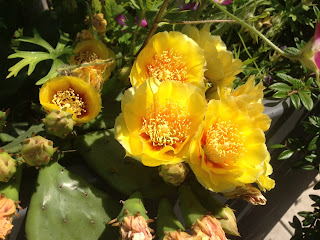
We'll still love it though - prickly pear can have a lot of uses, but our favorite on a Friday afternoon is the Prickly Pear Cactus Mojito. Happy Friday!


You'll notice the native prickly pear, our own Opuntia humifusa, is now in bloom for a limited time engagement. After this it will just go back to being a prick, so enjoy it now!

We'll still love it though - prickly pear can have a lot of uses, but our favorite on a Friday afternoon is the Prickly Pear Cactus Mojito. Happy Friday!
Tuesday, June 25, 2013
Exciting News - Green Roof Tax Abatement Extended
The New York State legislature extended and improved the NYC green roof tax abatement! New changes allow the maximum value to be doubled, which means property owners can save as much as $200,000 per project. It also encourages the use of biodiverse plants (we love!)
Our friends at S.W.I.M. broke the news and we couldn't be happier! They've also shared their independent evaluation of the NYC Green Roof Tax Abatement report which assesses the efficacy of the abatement.
Proving its a good time to go green!

Our friends at S.W.I.M. broke the news and we couldn't be happier! They've also shared their independent evaluation of the NYC Green Roof Tax Abatement report which assesses the efficacy of the abatement.
Proving its a good time to go green!
Friday, June 21, 2013
The Grass Is Greener
Today
is just the perfect Friday, and while this is perfect weather for many
of you and many of your plants, it is unfortunately also the perfect
weather for weeds too. Remember to get out there and stay on top of
weeding before the mugwort has reached 10’ high!
Its
also a good time to cut back tall plants that look better a little
shorter: coreoposis, eupatoirum (Joe Pye Weed), Balloon flower, and
Asters. We’ve been tending to one of our very lush green roofs in
Brooklyn - you can see the Mexican Feather Grass is thriving!


Including
another green roof in Tribeca where the same grass is looking
beautiful. We’ve experimented with potting this grass in planters before
with fatal results - the drainage was just not good enough and there
was way too much irrigation. Green roofs are perfect for this grass,
they provide excellent drainage and are generally dry, sunny landscapes.


*Baby not included with green roof installation.
Want some more tips? The lovely Jeanne Rostaing featured one of our recent projects in Fort Greene, and I sat in for some Q&A.
Monday, May 6, 2013
Pfizer Goes Green!

The former Pfizer building located in South Williamsburg, Brooklyn is getting a green roof paid for by the Department of Environmental Protection Green Infrastructure Grant. Alive Structures partnered with the buildings new owner, Acumen Capital Partners, to apply for the grant, and we received it! The roof will be 28,000 SF of sedum and native plants, there will also be a section for agriculture.
The building where Viagra was once manufactured is now an incubator for hip Brooklyn food start ups like McClure’s Pickles, Brooklyn Soda Works, Steve’s Ice Cream andMadécasse, to name a few. The building is perfect for food production with all of it's laboratories, sterile environment, and climate control storage. Acumen Capital Partners is committed to restoring old factory buildings and keeping them for local industry as opposed to making a quick buck and turning them all into "luxury lofts". We're hoping for a fall installation. Stay tuned for more news about it as we move forward.
See the DEP press release to find out about all the Green Infrastructure Projects chosen for 2013.
Here we are at the opening ceremony which took place on the Pfizer building last week.
 |
| Marni in the middle of a sea of suits. On the Pfizer Building with DEP. |
Tuesday, April 9, 2013
Coldspring to Heatwave
 |
| Star Magnolia in full bloom at 23rd St. |
This is your plant this past month:
'It's snowing, no way I'm gonna come out now.'
'Nice, finally! I'm going to send out some new growth.'
'Still nice. Sweet! I'm gonna bud.'
'Damn! I'm freezing my buds off! My owner's going to think I'm dead now. And I might be....'
'Oh, good. I'm still alive, and it's nice out again. I wish my owner would water me and stop thinking I'm dead.'
'Damn! It's hot!!!! Water! Agua! Eau! What language do I need to speak to get you to water?!'
Remember to water your gardens, green roofs, and especially potted plants, even when it goes back down to 50 deg.
Monday, March 25, 2013
Coldspring / Hot Blog
 |
| Natasha and Marni Majorelle, March 2013, Prospect park- Forest School! |
The first thing I'm doing is returning to the office - at good old 33 Flatbush! A few things have changed, like a gigantic tower built next door and this terrifying crane. Other than that it's still the great old place it's always been with amazing people and businesses.

 |
| Witchhazel in bloom in Madison Square Park. |
These unusual blooms look like yellow fire crackers or shooting stars.
So even though you're freezing and haven't finished your taxes, prune your rose (learn how!), cut down the grasses (if you haven't already in the fall), remove all those unsightly leaves surrounding the gorgeous blooms on your hellebore, add some mulch and compost, warm up, and then have a beer and gulash! It will be 90 degrees before you know it.
Tuesday, February 21, 2012
Tell the EPA to raise water quality standards!

People swimming at Coney Island in 2010. Image via.
The proposed standards are not strict enough. They allow for 90 averaging of pathogen levels, a period almost as long as New York City's beachgoing season. As S.W.I.M. put it in their email, "Under the proposal, the pathogen levels could be unacceptably high every Saturday during the beach season but the 90-day average may still meet the standards." And this does happen - Riverkeeper, a New York non-profit, tests water quality at a variety of locations around New York City. Their Pier 96 at West 56th St testing location is a boat launch and recreational kayaking spot for New Yorkers. Enterococcus counts (fecal pathogens) at Pier 96 failed water quality standards on four of the six testing days in 2011, and got as high as seven times the limit on one dirty day in May, but if the tests in the ~90 days between Memorial Day and Labor Day are averaged the water quality was acceptable.
Gross.
National Resources Defense Council has a petition to the EPA urging them to make these regulations stricter. Today's the last day to comment so we hope you'll sign!

Kids are particularly vulnerable to getting sick from dirty water. Image via.
Wednesday, February 15, 2012
More Terrariums, if possible....

I know the design world is gaga about terrariums. Maybe they've become so trendy, that they're actually no longer in style. This sentiment is expressed in the blog site I was sent by an architect friend : fuck your noguchi coffee table, which states "fuck your terrarium lamp" with image below.

Nonetheless, my enthusiasm for terrariums is actually just now blossoming.
I'm attaching some images of a terrarium we built for a client using a vessel made from recycled glass. The vessel was pretty expensive because of it's elegant shape and lightweight material. But there are plenty of glass jars and pre-existing terrarium like containers which could be used for free or for little cost.
What's fun about building terrariums is the creation of another world and experimenting with different types of plants. I built this one with my mom which was fun. But also getting the plants through the bottleneck and into the soil can be a bit nerve racking. Anyway, nothing is very satisfying unless there's challenge involved.


Friday, January 20, 2012
Sharks! Stingray! Lion Fish!! Palm Trees!
 Blogging about a recent trip to the caribbean is not intended to make anyone jealous, but simply to share interesting ecological information-but, yes, my tan looks great, thanks :)
 My family and I stayed for one week in Guanica, Puerto Rico beside the largest remaining tract of tropical dry coastal forest in the world, which was declared an International Biosphere Reserve by UNESCO because of its biological diversity. The forest feels both tropical and desert. Walking on it's trails, one is surrounded by low growing twisted shrubs, barrel cacti, cactus trees, but also palm trees and the turquoise ocean (also a few nice gay beaches if anyone's interested).
The dry forest has 700 plant species of which 48 are endangered and 16 exist nowhere else. Its forest hosts the greatest number of bird species on the island, including the Puerto Rican Emerald Hummingbird which pollinates the flowering barrel cacti in the winter months.


In the same region are lush mangroves and coral reefs. Home to manatees, nesting sites for Hawksbill turtles, and crested toads. While we didn't see manatees, we did see many beautiful fish and coral. (Beautiful underwater image of elkhorn coral by my brother Joshua Horwitz) See one of my favorite quirky fish, the Spotted Trunkfish.


Nearby, is a rare Bioluminescent Bay, which we did not visit but heard lots about. In this bay are 720,000 single-celled organisms that glow when they are agitated. This illumination is a defense mechanism by the tiny plankton that will dim and disappear if you hold completely still. These bays are scarcely found internationally because of the delicate ecological balance they require. Unfortunately, visiting this bay and experiencing a bit of it's magic probably damages it more since people wear mosquito repellent and carry other pollutants into the water.


Coral reefs, which take centuries to form, are also damaged by people's visitations. Coral is often broken by careless snorklers, motor boats, and pollution. But the larger threats to reefs are global warming and ocean acidification. According to Environmental Health Perspectives a heat wave starting in 2005 left roughly 60% of the coral cover in the Virgin Islands and 53% in Puerto Rico’s La Parguera Natural Reserve dead. This is an unprecedented tragedy.
Coral reefs consist of a variety of colors shapes and textures. Sometimes they echo the landscape on the ground, looking like a tall cacti , but many of the shapes you never find on land, like coral fans.


For a horticulturist, seeing the varieties of coral and the rich world it creates is like exploring a beautiful botanical garden. The problem is you don't want to get too close; you risk damaging the coral with your flippers and can get burned and scratched by it.
The amazing fish that would swim in and out of the coral were like watching people inhabit a busy building. Sometimes the coral was so busy and full of fish it was like Times Square.
One fish, though very beautiful, is quite dangerous, the Lion Fish. The Lion Fish is originally from the Pacific Ocean and has no known predators in all of the Atlantic. Their introduction is a result of hurricanes and tank releases during the early 1990’s. Due to their population explosion and aggressive behavior, Lion fish have the potential to become the most disastrous marine invasion in history by drastically reducing the abundance of coral reef fishes and leaving behind a devastated ecosystem. In Puerto Rico, the government offers $1 for every dead Lion Fish someone turns in. Also, some restaurants have started serving Lion Fish which is said to be tasty. I think dealing with invasive species through culinary strategies is a great idea!
 Photo by Josh Horwitz!
After a week in Puerto Rico, Eric and I traveled to St. Johns for a week. This will have to be a whole other blog, but I do want to share some images of the exciting larger wildlife we saw underwater, such as nurse sharks, reef sharks, spotted eagle sting rays, and green sea turtles. Scary but fun!


Subscribe to:
Posts (Atom)


