Friday, August 26, 2011

What happens to a suburban dream deferred?

What happens when there isn't enough water to sustain a landscape? Does it shrivel up in the sun until there's nothing left? What about suburban populations faced with the realities of an arid climate met by climate change?

Photo via NPR.

We caught two harrowing NPR morning edition segments on the drought in Texas today. One discussed the effect the drought is having on local ecologies. The earth is dry so the plants are dry, so insect populations are decimated, so the bat colonies don't have anything to eat, and squirrels and deer don't have enough milk to feed their babies, and on and on. Desert ecosystems are fragile, supporting life with severely limited resources. Human development is one of the main causes of desertification, and the Southwest experienced a boom in population growth in the last decade.
Areas in red are high vulnerability of desertification. Credit USDA.

Texas started recording meteorological data in 1895 and in 116 years, this is the driest it's ever been. This year has been marked by extreme weather across the states, from a record-breaking snowstorm in the northeast last winter, to the record-breaking heatwave in July, to the hurricane currently approaching the east coast.

As climate change progresses over the next century, extreme weather will become far more frequent. We've had above-average yearly rainfall in New York City every year for the past 10 years. At the same time, the West is getting drier. Our climate is polarizing, and these changes are going to take a toll on wildlife across the board as it struggles to adapt biologies developed over thousands of years within the span of a few decades. One might think it would be easier for humans to adjust our consumptive industries and aggressive colonization customs, but perhaps the instincts behind these habits are as much a product of evolution as the drought-tolerant nature of Sunset Hyssop (native to Arizona and New Mexico).

Agastache rupestris is a fragrant member of the mint family and a hummingbird favorite. Photo via.

Native plant shout-out accomplished, I wish you a good (and safe) weekend.

Friday, August 19, 2011

Native Appreciation: Divine Edition


Photo via Marie Laser.

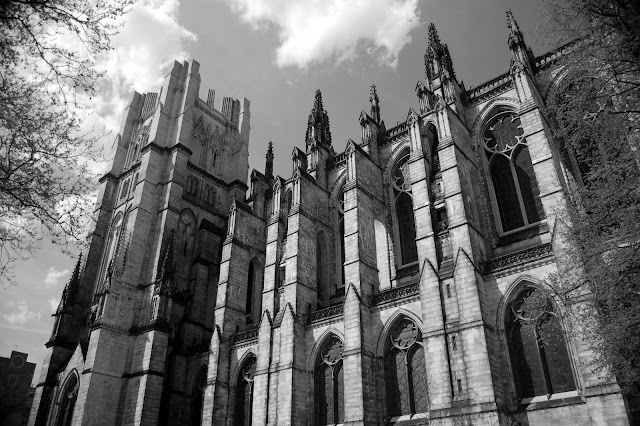
Yesterday morning Marni and I took a tour of the Cathedral of St. John the Divine in Morningside Heights. If you live in NYC and you haven't been, put it on your to do list. I found myself wondering if I had somehow taken the 1 train to France, England, or similar gothic cathedral territory (if you've ever sat on the train from Brooklyn to the Upper West Side you know it feels plausible). St. John is huge; it is the fourth largest Christian church in the world, and the architecture is stunning, though perhaps doomed to be eternally unfinished. The 11 acres of grounds that surround the cathedral are beautifully landscaped, dotted with sculpture, and home to three peacocks.

A peek into the Biblical Garden.

Surprise peacock.

Perhaps more incredible than the interior and grounds is the roof. We hiked up a dark stone spiral staircase and out onto this:

Plants growing on the roof!

Under the buttresses.
A few blocks away is the rain garden we recently completed at Columbia's Teachers College. We headed over there to do see what's blooming and take some photos.

In the above photo you can see a cultivar of Joe Pye weed called "little Joe" (tall, pink and in the center), latin name Eupatorium dubium, and fameflower, or Talinum calycinum. Joe Pye weed is native to the east coast.


Fameflower is a favorite at Alive Structures. It's such a champ! It has been blooming for a month now and just keeps going. We love the way it looks against the rocks, and we often use it on green roofs as well. Fameflower is very drought tolerant, versatile, and one of the few succulents native to North America.


Last is this Great Blue Lobelia, or Lobelia siphilitica. This is in the bellflower family and just looks like it belongs in swampy habitats (it does) - perfect for rain gardens. Unfortunately it is listed as endangered in Massachusetts and exploitably vulnerable in New York.

Thursday, August 11, 2011

Native Appreciation: Swamp Beauties

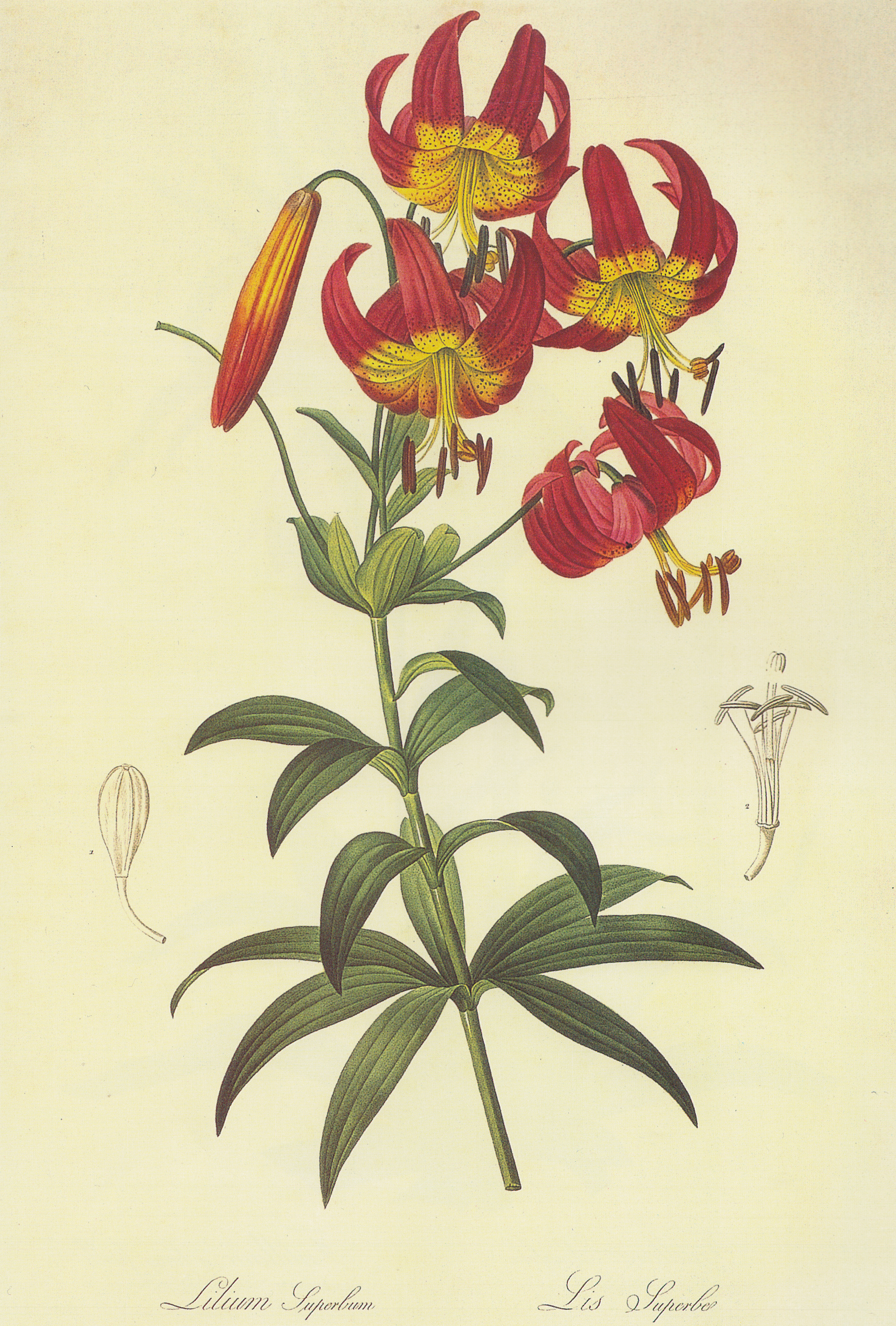
This gold and orange firework of a flower is the Turk's cap lily, or Lillium superbum. Surperb. It's native to swamps and wetlands in the eastern half of North America. You can eat the bulbs, but please don't; it's classified as Endangered and Expoitably Vulnerable by the USDA.

Lillium superbum reminds us of a shooting star by its shape, but it's colored like a fireball; bright yellow in the center, turning orange and then red at the tips of the petals. Other notable features include the whorled leaf pattern, shown in the illustration below. In phyllotaxis, whorled means that leaves circle the stem at the same levels.

A botanical drawing circa 1816. Via Wikimedia Commons.

Of course, the first thing one wonders when seeing Lilium superbum in nature, is where can I get one? Why don't most people grow these in their gardens instead of all the asian tiger lillies and day lillies? As it turns out, this lily can take up to seven years from seed to bloom, which might make it expensive or discouraging for many nurseries and gardeners to grow. Since we're young and adventurous we're going to give it a try. Look for an update in 2018!

Turk's cap lily in the wild.

I bet you didn't know there are hibiscus native to New York. The flower in the above photo is Hibiscus moscheutos, common name rose mallow. Its territory is similar to that of the Turk's cap lily, but extends as far west as Utah.

Rose mallow and swamp milkweed at dusk.

Our last moisture-loving flower is Asclepias incarnata, or swamp milkweed. It blooms little pink flowers like crested jewels, and as a milkweed, is a favorite food and breeding habitat for monarch butterflies. It's native to almost the whole of North America, barring the west coast.

All of these photos were recently taken by Marni during some nature spelunking in Little Compton, RI. Tragically the flowers were mostly surrounded by phragmites, Japanese honeysuckle, Russian olive, wild grape, and many more invasive species. One has to wonder what coastal Rhode Island looked like two hundred years ago, and what gems we've lost since invasives started crowding everyone out.

Friday, August 5, 2011

Truman Capote's Green Roof

In early June, Alive Structures collaborated with the sustainable Hamptons-based architecture firm Modern Green Home to install a green roof in Southampton. We used ultra light-weight green roof soil by The Gaia Institute and pre-grown sedum mats intermixed with native dune grass and prickly pear on this 500 square foot green roof in Sagaponack.

Technicolor sedum mat.

The house's current owner told us that while clearing the invasive honeysuckle and japanese knotweed plants that had taken hold of the property he had unearthed a number of aged Veuve Clicquot bottles nestled in the undergrowth. We can only wonder how they got there, but to fuel your imagination, the beach house originally belonged to Truman Capote. It was an honor to do a green roof on the house that Mr. Capote occupied from 1961, when he commissioned it, until his death in 1984. We just got these photos of the roof in bloom.


In a 1976 profile of the house, Architectural Digest described the surrounding landscape as "a stretch of rolling potato fields and lush farmlands married to the nearby Atlantic Ocean." In the same article, Capote described it as “Kansas with a sea breeze.”

Capote at home. Photo via Architectural Digest, kind of.

Both the dune grass and the prickly pear (seen peeking out from the blooming sedum in the photo at the top) we planted on the roof are native to the area. We used dune grass as a nod to both the location and the spirit of the beach house. Many people find it hard to believe that eastern prickly pear (Opuntia humifusa), a cactus, is native to the Northeast, but in fact it grows as far north as southern Ontario.

Some photos from the installation, below.
Marni and Orlando with a prickly pear.


Friday, July 29, 2011

July S.W.I.M. Meeting


Monday morning was cool, overcast and a little windy. After the sweltering soup we waded through last weekend, this was beautiful weather. I was thrilled to be out in it, and excited to attend the Storm Water Infrastructure Matters Coalition meeting. S.W.I.M. is a group of New Yorkers dedicated to improving water quality in the city's rivers and estuaries through equitable distribution of green infrastructure.

The chickens and Annie Novak, Eagle Street's head farmer. Via The Atlantic.

The July meeting was held at Eagle Street Rooftop Farm in Greenpoint, Brooklyn. We sat on a small platform in the midst of a lovingly farmed green roof. Behind our group, chickens scratched in their coop and troops of city kids toured the farm. In front of us, midtown towered gray and reflective. The meeting opened with a presentation by Tyler Caruso and Erik Facteau about their research project, Seeing Green: The Value of Urban Farms, recently funded on Kickstarter. If they hadn't already raised the amount they were looking for I'd tell you to go donate; the project hopes to determine whether rooftop farms are equivalently efficient at capturing stormwater as traditional green roofs. This research could be used to make New York's green roof tax credit applicable for rooftop agriculture, which it currently isn't.

A still from the Seeing Green Kickstarter video showing Tyler and Erik on the roof at Brooklyn Grange farm.

The rest of the meeting centered around the previous week's combined sewer overflows, discussed in our last post. S.W.I.M.'s members were not happy.
The July meeting, from the S.W.I.M. blog.

They had reason. Notification of the CSOs was insufficient, and many of the boaters were either out on the water themselves or had groups of people (including high schoolers) in the water while sewage was being released nearby. The NYC DEP sent some representatives, though if they were trying to do damage control they weren't very successful. The unlucky, besuited bureaucrat who took questions was evasive and non-commital. The scene could easily be caricatured: clean-cut government employee yelled at by environmentalists over inadequate response to emergency. But the passion exhibited by the members of S.W.I.M. wasn't amusing, it was awesome. I left thinking that New York is lucky to have such people looking out for our waters and our health.

For in-depth notes on the points covered in the meeting, head over to the S.W.I.M. blog.

Monday, July 25, 2011

Sewage in New York's Rivers

A sewer outfall a few blocks north of Christopher Street in Manhattan on the morning of July 22nd. | Photo credit SeaAndSkyNY

If you live in New York City, you probably know by now that a pump engine fire shut down the North River Wastewater Treatment Plant at 125th St. last Wednesday night. Over the following two days, raw sewage was diverted from the plant into the Harlem and Hudson rivers, to the tune of about 200 million gallons.

Smoke from the fire fills Riverbank Park nearby. | Photo credit @phlpp7r

It was particularly unfortunate that the sewage outfalls contaminated New York's waterways the same weekend that temperatures in the city reached 104, a record high. The city issued an advisory warning against swimming at three beaches in Staten Island and one in Brooklyn, but it wasn't clear how effectively the warnings reached New Yorkers. The New York Times reported visitors with small children at two of the beaches who were unaware that the water was unsafe, and people were seen fishing in Staten Island and the Harlem river. Both activities carry serious health risks, and it may be that we need better systems for informing the public of CSOs (combined sewer overflows). As someone pointed out at this morning at a S.W.I.M. Coalition meeting, subsistence fishermen in East Harlem probably don't read press releases.
A floating barrier near the treatment plant. | Photo credit NYTimes

While this event was unusual in its scale and origin, the sad truth is that CSO events are not uncommon. They happen at various outfalls around the city almost every time it rains.

Wednesday, July 13, 2011

Manhattan's Newest River

We are so excited that the New York Times featured our rain garden at Teachers College in the Home section in the Thursday, June 30 issue. If you missed it, you can still access the article online. Enjoy the photos from the installation!